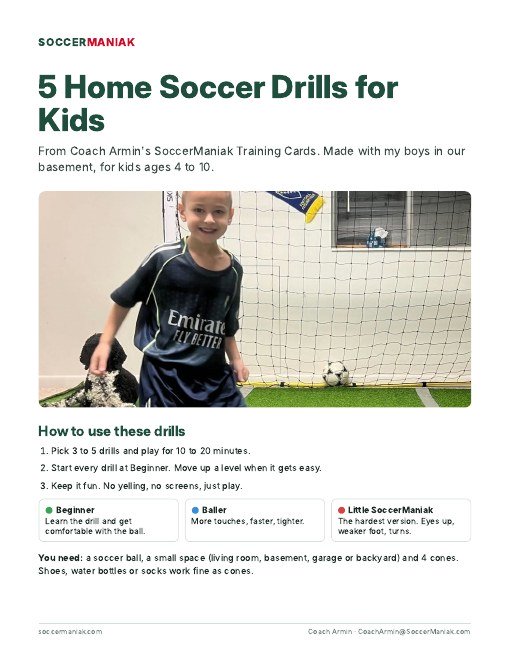
Free for parents: 5 home soccer drills from Coach ArminGet them
Rules of Soccer: The 17 Laws in Plain English for Parents and Players
The rules of soccer come down to one simple idea: get the ball into the other team's goal without using your hands (unless you're the goalkeeper), and score more goals than they do. The official rules are called the 17 Laws of the Game, and everything from your kid's Saturday morning game to the World Cup is built on them. Below I explain all 17 in plain English, plus how the rules change for kids at each age.
"If it moves, kick it. If it doesn't move, kick it until it does."
That's the only rule you really need when you're playing for fun :)
Grab a few friends and a ball, set up two goals with backpacks, shoes or rocks, and try to put the ball between the other team's posts without using your hands. Whoever scores more wins. Out of bounds and fouls get called by the players, and the rules are made up as you go.
No ball? Anything lying on the ground will do: a soda can, even a small rock. For some odd reason, kicking stuff on the ground is a lot of fun. Some of the greatest players in the world fell in love with this game on long walks to school, kicking whatever they found along the way.
Once kids start playing in a league, though, soccer gets more physical and the game needs real rules to stay organized, fair and safe. That's what the official rules of soccer, the Laws of the Game, are for.
Where the Rules of Soccer Come From
The first official rules of soccer were written in 1863 at the Freemasons' Tavern in London, when the new Football Association got English clubs to agree on one set of rules. They called them the Laws of the Game, and the name stuck.
Today the Laws are written by the IFAB (International Football Association Board), a group made up of FIFA and the four British football associations. The basic idea hasn't changed since 1863, but the details get updated every summer. In 2026 alone we got a 5-second countdown on throw-ins and goal kicks and a 10-second limit for players coming off on substitutions.
The 17 Laws of the Game at a glance. Each one is explained in plain English below.
The 17 Laws: Rules of Soccer in Plain English
Here's every law, short and simple. Where I have a full page on a rule, I've linked it so you can dig deeper.
The Field of PlayA rectangle with a goal at each end. A full-size field is 100 to 130 yards long and 50 to 100 yards wide (international games use 110 to 120 by 70 to 80). The goal is 8 yards wide and 8 feet high, and the penalty spot is 12 yards out. All the measurements are in soccer field dimensions.
The BallA full-size ball (size 5) is 27 to 28 inches around and weighs 14 to 16 ounces. Younger kids use smaller balls, which I cover in the youth section below.
The PlayersEach team has up to 11 players on the field, including one goalkeeper. A game can't start or keep going if a team has fewer than 7. Pro games allow up to 5 substitutes, made in 3 stoppages plus halftime, and players who come off can't go back on. Youth leagues often allow unlimited substitutions, and players can come back in.
The Players' EquipmentMatching shirts, shorts and socks, shin guards and soccer shoes. The goalkeeper wears different colors from everyone else. No jewelry, and taping it over isn't allowed anymore.
The RefereeThe referee runs the game, and their decision is final. If you want to know what the whistles and arm signals mean, I explain them all in soccer referee signals.
The Other Match OfficialsTwo assistant referees with flags on the sidelines, a fourth official between the benches, and in pro games the video assistant referee (VAR). They help, but the referee decides.
The Duration of the MatchTwo 45-minute halves with up to 15 minutes at halftime. The clock doesn't stop, so the referee adds time at the end of each half for injuries, substitutions and time wasting. In knockout games a tie can go to two 15-minute extra-time periods and then penalty kicks. Youth games are shorter.
The Start and Restart of PlayA coin toss decides who kicks off. Every half and every goal restarts with a kickoff from the center spot, and you can even score straight from a kickoff. When the referee stops play for something like an injury, the game restarts with a dropped ball to the team that last touched it (to the goalkeeper if it happened in the penalty area), and everyone else stays about 4.5 yards (4 meters) away.
FREE5 Home Soccer Drills from Coach Armin
Plus SoccerManiak Weekly: my news round-up and one drill to try at home. Unsubscribe any time.
The Ball In and Out of PlayThe ball is out only when the whole ball crosses the whole line, on the ground or in the air. If even a sliver of it is on the line, it's still in. If the ball hits the referee and that changes who has it or starts a good attack, the referee stops play and restarts with a dropped ball.
Determining the Outcome of a MatchA goal counts when the whole ball crosses the goal line between the posts and under the crossbar. You can score with any part of the body except the hands and arms. The team with more goals wins. If it's a tie, the league decides: it stays a draw, or it goes to extra time and penalty kicks.
OffsideA player is offside if they're closer to the other team's goal than both the ball and the second-to-last defender when a teammate passes to them, and they get involved in the play. Standing there isn't against the rules. I explain it step by step, with a diagram, in offside in soccer.
Fouls and MisconductKicking, tripping, pushing, holding, charging into or jumping at an opponent gives the other team a direct free kick if the referee thinks it was careless. Reckless is a yellow card. Excessive force is a red card. Handling the ball on purpose is a direct free kick too (unless you're the goalkeeper in your own penalty area). Dangerous play without contact, like a high kick near someone's head, is an indirect free kick. And a goalkeeper who holds the ball longer than 8 seconds gives the other team a corner kick. More in soccer fouls.
Free KicksA direct free kick can go straight into the goal. An indirect one has to touch a second player first (the referee keeps an arm up to show it). Opponents must stand at least 10 yards away, and when the defense makes a wall of three or more players, attackers have to stay at least 1 yard away from it.
The Penalty KickFor a foul or handball by the defending team inside its own penalty area. The ball goes on the penalty spot, 12 yards from goal. The goalkeeper must have at least part of one foot on the goal line when the ball is kicked, and everyone else waits outside the penalty area until it's kicked. More in penalty kicks in soccer.
The Throw-In NEWWhen the whole ball goes over the sideline, the other team throws it in from where it went out. Both hands, ball from behind and over the head, and part of each foot on the ground on or behind the line. You can't score straight from a throw-in, and you can't be offside from one either. New for 2026: take too long and the referee counts down 5 seconds, then gives the throw to the other team.
The Goal Kick NEWWhen the attacking team puts the ball over the goal line, the defending team kicks it from anywhere in the goal area. The ball is in play as soon as it's kicked and clearly moves, even inside the penalty area, which is why you see so many teams playing short goal kicks now. New for 2026: the same 5-second countdown, and a slow goal kick gives the other team a corner.
The Corner KickWhen the defending team puts the ball over its own goal line, the attackers kick it from the corner arc closest to where it went out. Opponents stay 10 yards away, and you can score straight from a corner. It's rare, but it's one of the coolest goals in soccer.
Laws 8 and 13 to 17 on one field: where each restart is taken.
Coach Armin's tip: The rule young players break the most is the throw-in. One foot comes off the ground, or the ball gets thrown from the side of the head, and the throw goes to the other team. Practice it at home: both feet down, ball all the way behind the head, and throw with both hands at the same time. Five minutes in the backyard a few times a week and it'll never be a problem.
Youth Soccer Rules by Age
Kids don't play the full 11v11 game right away, and that's a good thing. Smaller teams on smaller fields mean every kid touches the ball a lot more, and touches are what make players better. Here's how it works in Utah Youth Soccer, which follows US Soccer's small-sided standards like most leagues in the country:
How many players, which ball and which rules at each age.
Age
Game
Ball
Halves
Rules to know
U6 to U8
4v4, no goalkeeper
Size 3
4 quarters, up to 10 min
No offside, no heading
U9 and U10
7v7
Size 4
2 × 25 min
Build-out line, no heading
U11 and U12
9v9
Size 4
2 × 30 min
Full offside, no heading
U13 and up
11v11
Size 5
2 × 35 min, longer as they get older
Full Laws of the Game
The build-out line is a line halfway between the penalty area and midfield. When the goalkeeper has the ball, the other team has to back up behind it so the defenders can learn to pass out from the back instead of just booting it. Rules change from league to league, so always check with your club for your kid's age group.
Playing by the Rules (and Keeping Your Cool)
The whistle has the final say, so learn the rules of soccer and save your breath for the game :)
Soccer is a contact sport played with our feet, after all. Getting pushed, kicked, stepped on and talked to is part of the competitive game, and referees won't see everything. They're human and they'll make mistakes.
What I tell players: when you lose your temper and complain about every call, your concentration drops and your game falls apart. Stay calm and keep playing with a positive attitude. Winning the game at the end feels a lot better than spending 90 minutes arguing with the referee.
The rules of soccer might look like a lot at first, but you've probably noticed they all come back to the same idea: play the ball, play fair, and keep the game moving. Learn the basics here, and the rest will make sense the more games you watch and play.