4-5-1 Soccer Formation
The 4-5-1 soccer formation is one of the most defensive shapes in soccer: four defenders, five midfielders and a lone striker. Teams use it to protect a lead or to stay hard to beat against a stronger opponent. Below I show three ways to set it up, explain what every position does, how to attack and defend with it, and my coaching tips, with diagrams for each one.
On this page: At a glance 3 ways to set it up Positions Attacking Defending Strengths and weaknesses Coaching tips Questions
The 4-5-1 Soccer Formation at a Glance
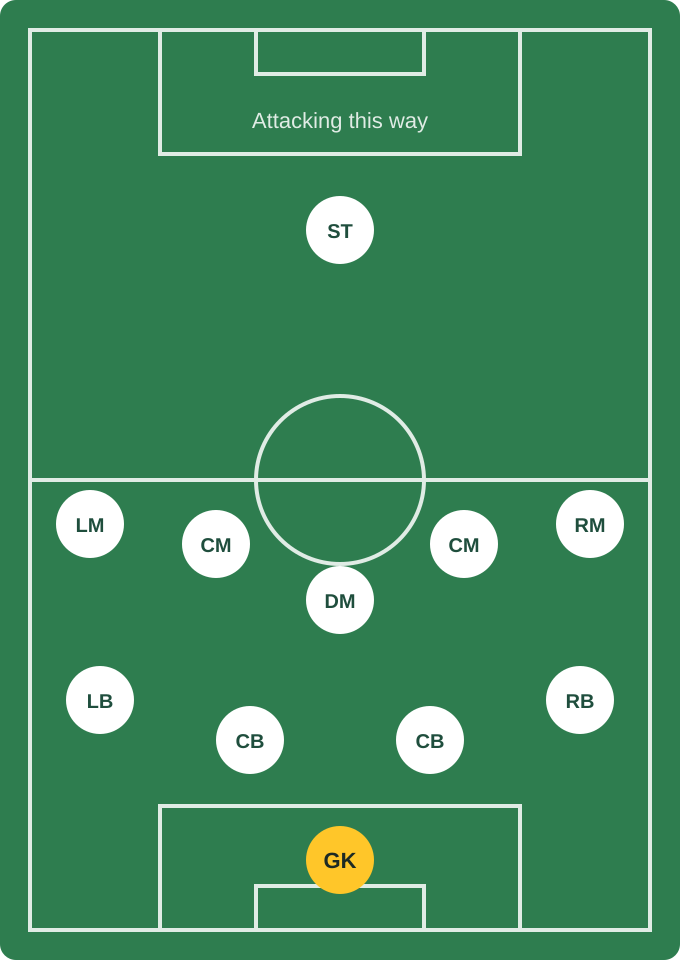
The 4-5-1 soccer formation is a very defensive shape: four defenders, five midfielders and one striker. Not many teams start a game with it. It is usually used when a team wants to protect a lead, needs a 0-0 draw, or is playing a much stronger, very attacking opponent.
It crowds the midfield and defends with nine players. The downside is in attack: one striker against three or four defenders makes it very hard to find space, so the midfielders have to join the attack.
| Line | Players | Main job |
|---|---|---|
| Defense | Left back, 2 center backs, right back | Defend first; full backs push only to the halfway line |
| Midfield | 5 midfielders | Keep the ball with short passes, then spread wide to defend |
| Attack | 1 striker | Win the ball, shield it and wait for the midfield |
3 Ways to Set Up a 4-5-1
The four defenders and the striker stay the same. What changes is how you arrange the five midfielders.
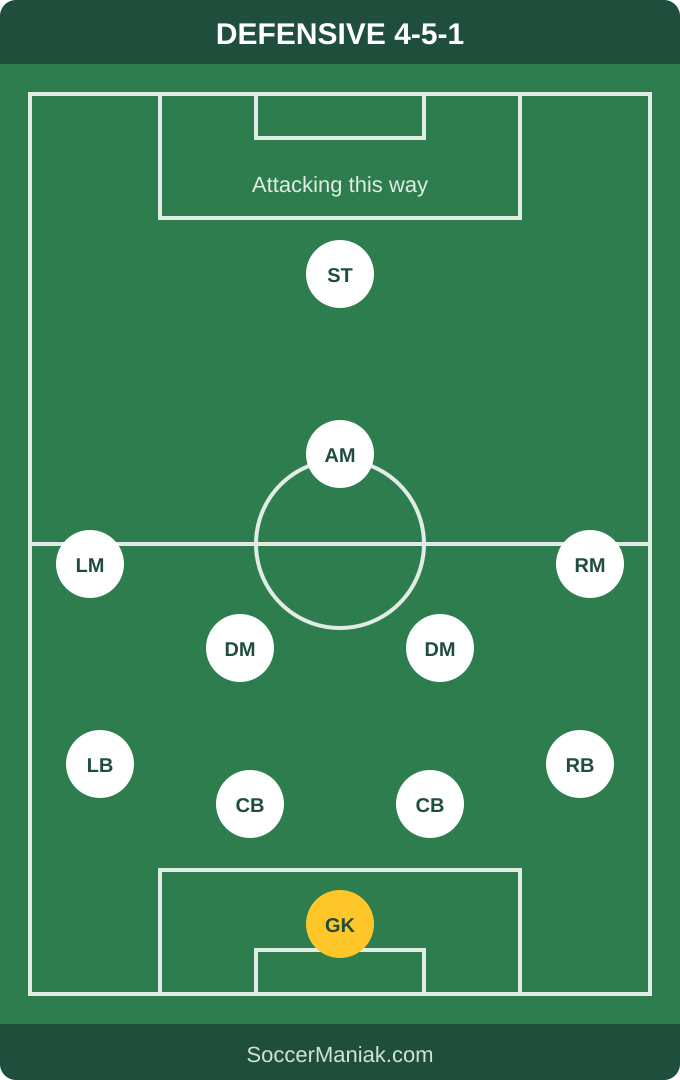
Defensive: two defensive midfielders close down the middle. Use it only with a lead, or against a much better, very attacking team. The midfield must spread out and talk, not crowd together.
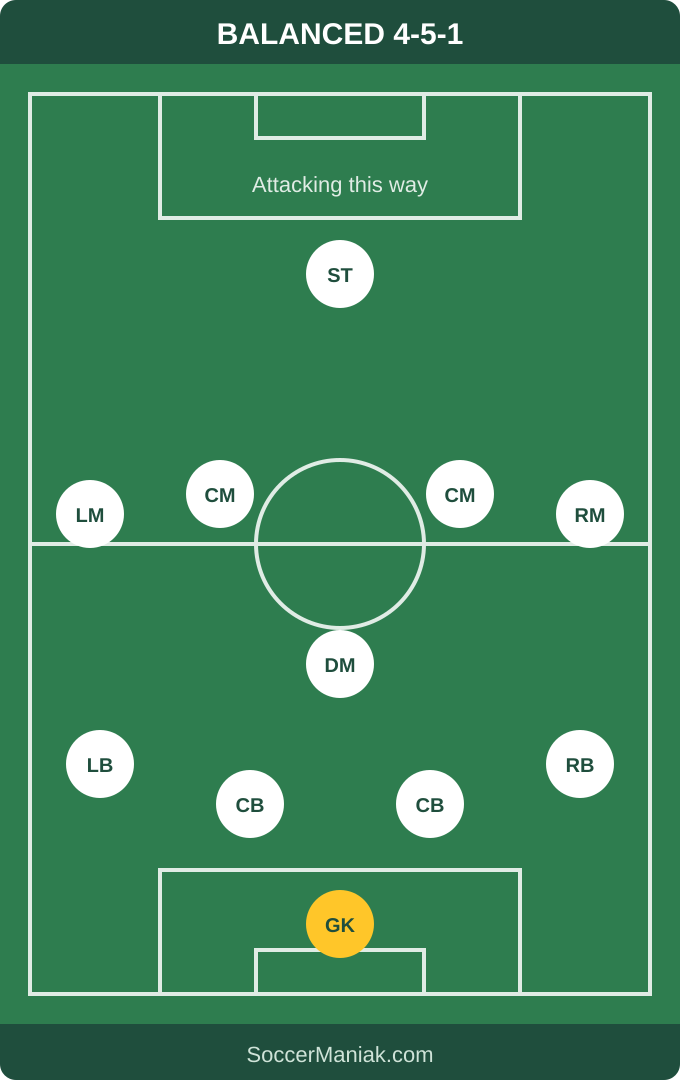
Balanced: one defensive midfielder helps the defense while two central midfielders support the striker. Crosses only work if the central midfielders run into the box to join him.
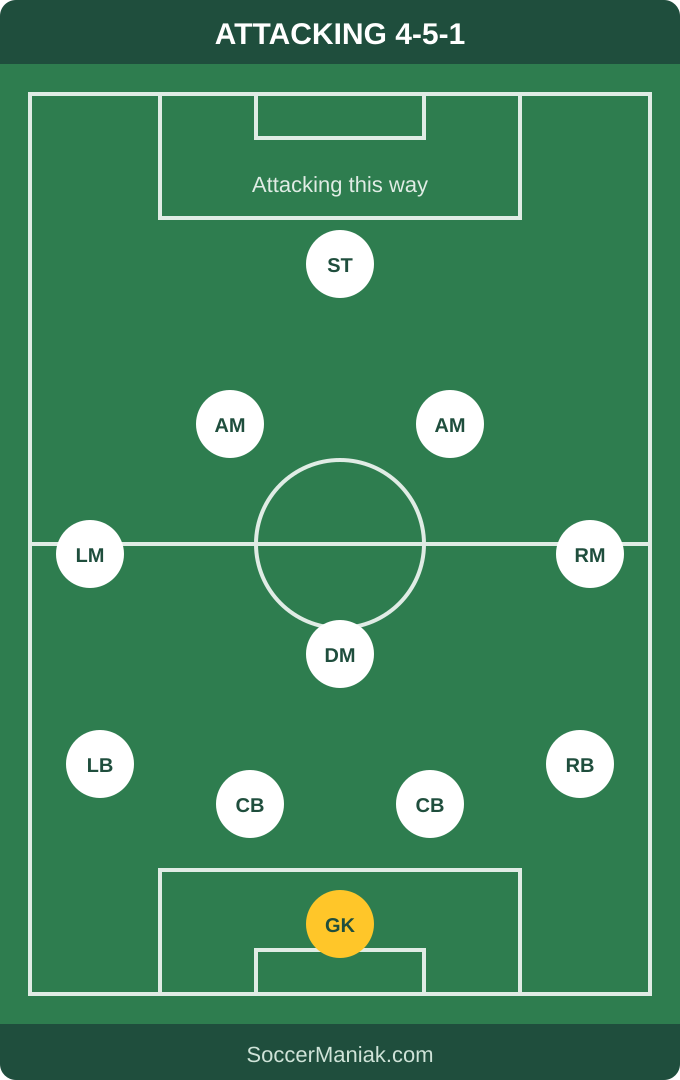
Attacking: one midfielder stays back while two play higher, close to the striker. The full backs stay home and defend, so at least five players are always defending.
New to the positions? See my soccer positions page.
FREE5 Home Soccer Drills from Coach Armin
Plus SoccerManiak Weekly: my news round-up and one drill to try at home. Unsubscribe any time.
Positions in the 4-5-1 Soccer Formation
Defense
Four defenders line up across the back: two center backs and two full backs. The center backs should be strong, good in the air and good at defending 1v1, and they have to talk all game, because they are the last two players in front of the goalkeeper. Communication closes down empty space and makes sure the line steps up together for offside traps. If you are new to that, see my offside in soccer page or the official Law 11 Offside from The FA.
For an even more defensive setup, one center back can drop 5 to 10 yards behind the other as a sweeper. The full backs should be quick, agile and good at stopping players 1v1. In a 4-5-1 they don't run all the way forward: they go up to the halfway line and hold there, so the wide midfielders can take the sidelines in attack.
Midfield
The strength of this formation is the midfield. Unlike other shapes, it attacks with possession and short passing, so all five midfielders need good ball skills and strong passing. They move the ball around, make the other team chase it and get closer and closer to the box with simple passes.
The defensive (holding) midfielders control the center of the field. They break up attacks, win tackles and headers, read the game well, and start most attacks with calm, simple passes. Their job is to protect the defense and stop attacks before they reach the center backs.
The central or attacking midfielders need great fitness, because they keep running up to support the striker and then sprint back to form the five-player midfield when the ball is lost. They need vision, ball control, quick passing and decisions, and ideally a good shot with both feet. These are often the players who get the most touches in practice.
The wide midfielders have the same skills. Since the 4-5-1 doesn't attack mainly down the sides, they don't need to be the fastest players. More important is shielding the ball and making quick passing decisions.
Forward
The lone striker is badly outnumbered, so chances are rare. The ideal player is big and strong, wins balls in the air, is very hard to take the ball from and needs only one chance to score. Their main job: receive the ball and keep it against at least two defenders for 10 to 15 seconds, until the midfield arrives to help.
Attacking With a 4-5-1
Attack with short passes and by outnumbering the other team in midfield. Be patient and move the ball with one and two-touch passing. Passing and moving is the key. The counter attack is also a great weapon: when the other team pushes extra players forward to try to break you down, a quick break can catch them.
Defending With a 4-5-1
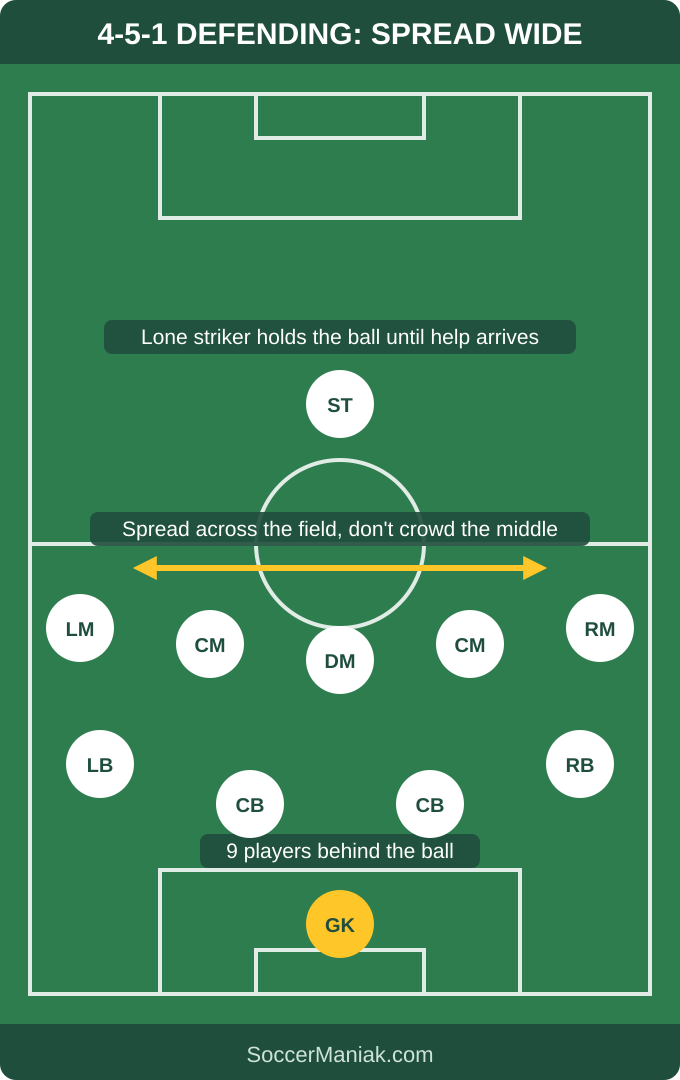
Defending in the 4-5-1 soccer formation is simple: don't crowd the middle. Spread the five midfielders wide across the field, don't chase the ball, and talk to each other about who takes which part of the field. At least eight players should be defending at all times.
Strengths and Weaknesses of the 4-5-1
Strengths
- Very hard to break down
- Five midfielders win the battle in the middle
- Great for protecting a lead
- Dangerous on the counter attack
Weaknesses
- The lone striker gets isolated
- Few players in the box for crosses
- Can sit too deep and invite pressure
- Midfielders need huge fitness to support the attack
Many teams that start in a 4-3-3 or 4-2-3-1 slide into a 4-5-1 shape when they defend, so learning it helps with those formations too.
Coaching Tips for the 4-5-1
- Use it with a purpose. Protecting a lead or facing a much stronger team are the right moments.
- Pick a strong target striker. Practice receiving and shielding the ball against two defenders.
- Train one and two-touch passing. This formation lives on short passes and patience.
- Teach the midfield to spread. Use cones to mark five lanes so midfielders don't bunch up.
- Practice the counter attack. Win the ball, find the striker, and get midfielders running past him.
For practice ideas, see my passing drills and youth soccer drills.
Common Questions About the 4-5-1 Soccer Formation
Is the 4-5-1 a defensive formation?
Yes, it is one of the most defensive shapes, with nine players who can get behind the ball. The attacking version gives you a bit more going forward.
What is the difference between a 4-5-1 and a 4-3-3?
Both use four defenders. A 4-3-3 has three forwards, while a 4-5-1 drops the two wingers back into midfield. Many 4-3-3 teams turn into a 4-5-1 when they defend.
Is the 4-5-1 good for youth soccer?
It can teach young players to defend as a team, but kids also need chances to attack and score. For most youth teams, a more balanced shape like a 4-4-2 is a better starting point. See the youth formations on my soccer formations page.