3-5-2 Soccer Formation
The 3-5-2 soccer formation puts five players in midfield, with three center backs behind them and two strikers up top. It is an attacking shape built on a strong midfield and fast wingbacks. Below I explain the W-shaped midfield, what every position does, how the defense holds it all together, its strengths and weaknesses, and my coaching tips, with diagrams for each part.
On this page: At a glance Wingbacks Attacking midfielder Defensive base Forwards Strengths and weaknesses Coaching tips Questions
The 3-5-2 Soccer Formation at a Glance
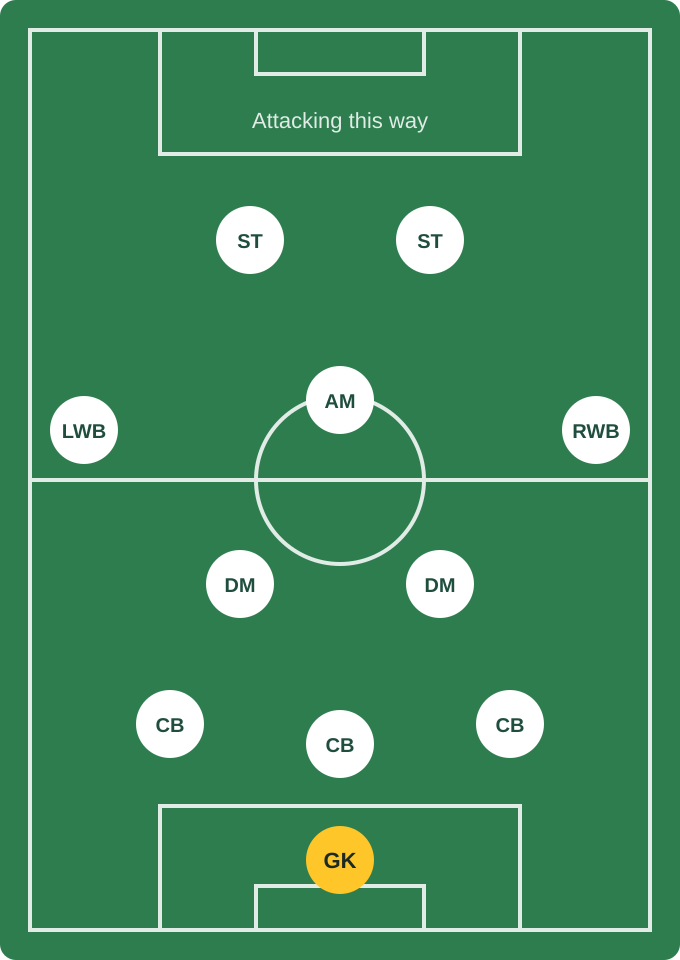
The 3-5-2 soccer formation uses three center backs, five midfielders and two forwards. Its strength is the midfield, which lines up like the letter W: two wide players (wingbacks), two defensive midfielders and one attacking midfielder. It is an attacking style of play that needs a skilled, calm midfield to keep the ball and build attacks.
| Line | Players | Main job |
|---|---|---|
| Defense | 3 center backs | Read the game, defend 1v1 and command the midfielders in front of them |
| Wide midfield | Left and right wingbacks | Run forward to cross, then track back to defend |
| Central midfield | 2 defensive midfielders, 1 attacking midfielder | The DMs protect the defense; the AM creates chances |
| Attack | 2 strikers | Attack every cross and shoot whenever they can |
New to the positions? See my soccer positions page, including the wingback role.
FREE5 Home Soccer Drills from Coach Armin
Plus SoccerManiak Weekly: my news round-up and one drill to try at home. Unsubscribe any time.
The Wingbacks
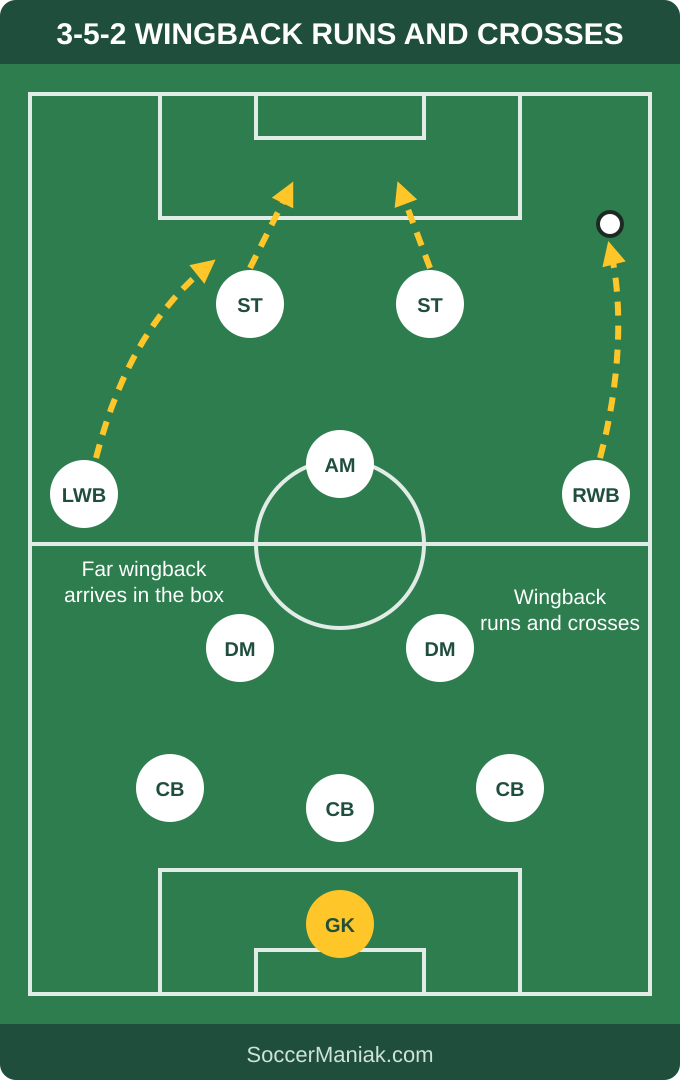
The two wide players are the engine of the 3-5-2 soccer formation. They make frequent runs forward and support the attack with crosses, so they need to be quick, skilled and confident taking on players 1v1. When the right wingback crosses, the left wingback should be in the penalty box, or at least at the edge of it, looking for a chance to score, and the other way around.
They also have real defensive work. As soon as the attack is over, both wingbacks have to sprint back and defend. Put your quickest, fittest players here.
The Attacking Midfielder
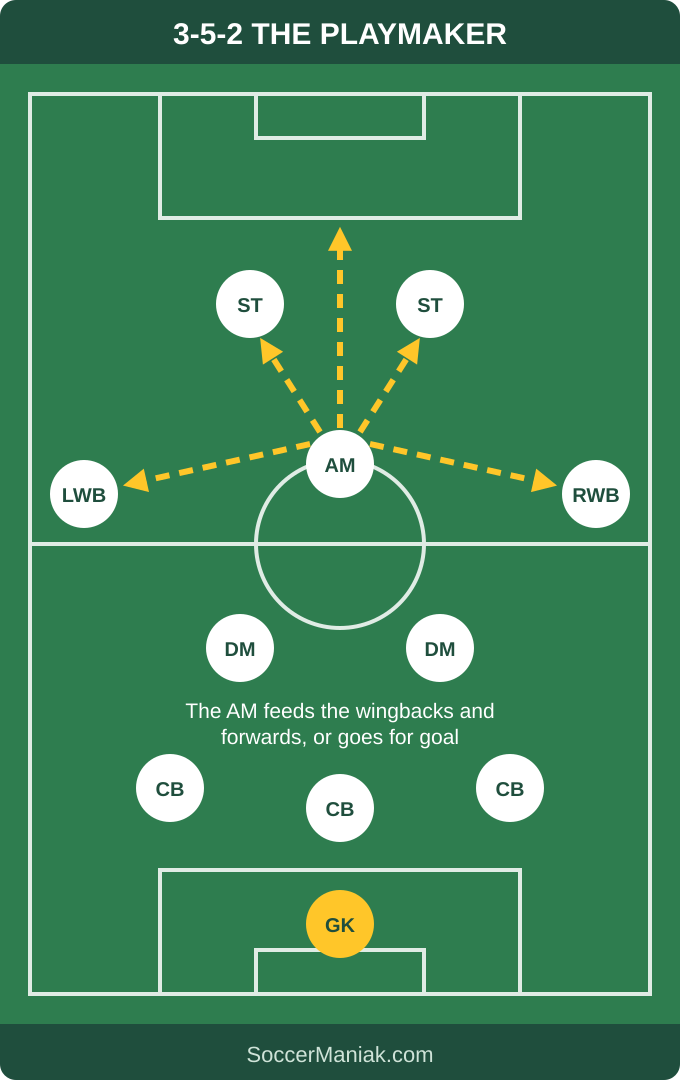
The attacking midfielder has the freedom to go anywhere on the field. This player needs great vision, reads the game well, and has excellent ball control, passing and quick decisions. A good shot from distance is a big plus.
Their job is to make others look good: passing to the wingbacks so they can cross for the forwards, or slipping a pass straight through to a striker. In other words, they help score goals, either by scoring themselves or by setting up others. Their defensive work is lighter, but they help out when the other team attacks with a lot of players. On most teams, the best player gets this role.
The Defensive Base: 3 Center Backs and 2 Defensive Midfielders
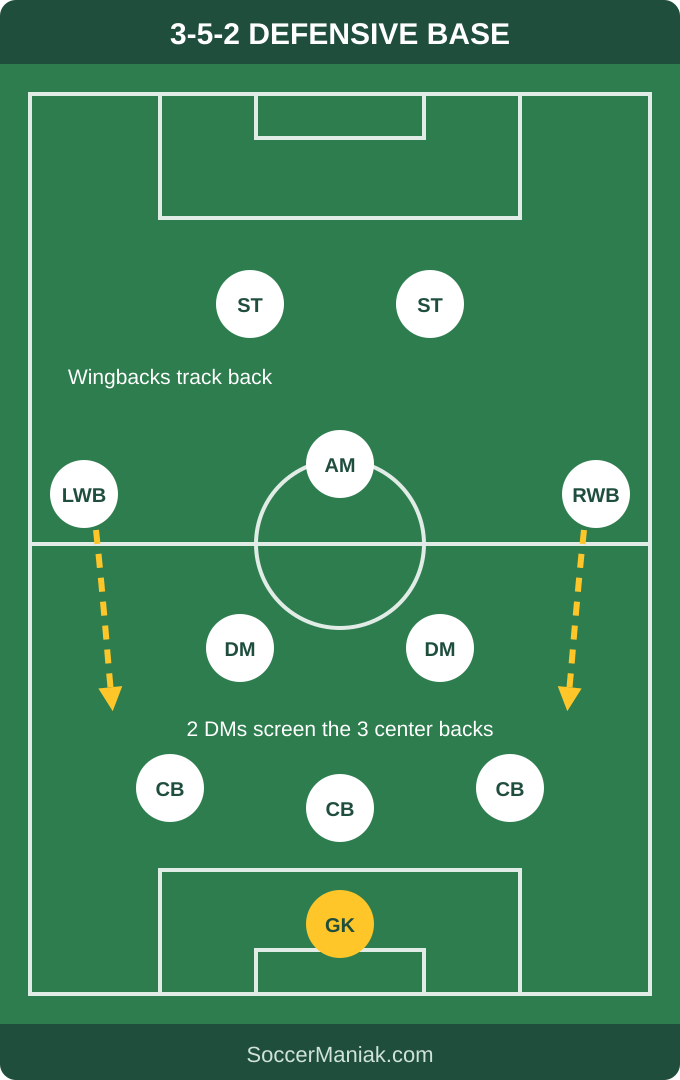
The two defensive midfielders control the middle by breaking up the other team's attacks. In attack they push about 20 yards into the other half to give a safe pass back. They need to be strong, good in the air, great at defending 1v1 and not afraid to tackle. They also have to stay calm on the ball and pass well, because their main job is to protect the defense and stop attacks before they reach the center backs.
The three center backs read the game, defend 1v1 and command the two defensive midfielders in front of them. The key ingredient is communication, to close down every empty space and every opponent. They should practice the offside trap together, which only comes with practice and constant talking. If you are new to that, see my offside in soccer page or the official Law 11 Offside from The FA. If the trap isn't working, the middle center back can drop back as a sweeper.
The Forwards
The two forwards are there to score goals and win games. They have the freedom to move anywhere and should shoot whenever they get a chance. Every time the ball is crossed into the box, both forwards need to be there to attack it. A player who never shoots never scores.
Strengths and Weaknesses of the 3-5-2
Strengths
- Five midfielders control the middle
- Two strikers to attack every cross
- Wingbacks give width on both sides
- A free playmaker behind the strikers
Weaknesses
- Big space behind the wingbacks if they get caught up the field
- Wingbacks need huge stamina
- Only three defenders against teams with wide attackers
- Needs a lot of practice and communication
In my experience, the 3-5-2 is most effective against a 4-4-2, because your five midfielders outnumber their four, and most vulnerable against a 3-4-3, whose three forwards go one on one with your three center backs.
Coaching Tips for the 3-5-2
- Midfield needs endurance and speed. This is the most important part of coaching the 3-5-2.
- Quickest players on the wings. Put them at wingback and practice crosses and 1v1s with them.
- Strong, smart players at defensive midfield. Work on headers and 1v1 defending.
- Your best player at attacking midfield. Pick the one who loves to score and always finds the ball in practice.
- Talk, talk, talk. Communication is the key to success with every formation. Players should always talk on the field.
- Be patient. A 3-5-2 takes hard work in training before it works in games.
For practice ideas, see my passing drills, soccer shooting and youth soccer drills.
Common Questions About the 3-5-2 Soccer Formation
Is the 3-5-2 a defensive or attacking formation?
It is mostly attacking, with five midfielders and two strikers. But when the wingbacks track back, it can defend with five across the back.
What is the difference between a 3-5-2 and a 3-4-3?
Both use three center backs and wingbacks. A 3-5-2 has an extra midfielder and two strikers, while a 3-4-3 has two central midfielders and three forwards, so it is even more attacking.
Is the 3-5-2 good for youth soccer?
For older 11v11 teams with fit, fast wide players, yes. Younger teams usually do better with a simpler shape. See the youth formations on my soccer formations page.