4-3-3 Soccer Formation
The 4-3-3 soccer formation is one of the most popular attacking shapes in the game: four defenders, three midfielders and three forwards. It gives you width, pressure high up the field and a solid base in defense. Below I explain every line of the 4-3-3, how it defends and attacks, its strengths and weaknesses, and my coaching tips, with diagrams for each part.
On this page: At a glance Defending Midfield Attacking Strengths and weaknesses Coaching tips Questions
The 4-3-3 Soccer Formation at a Glance
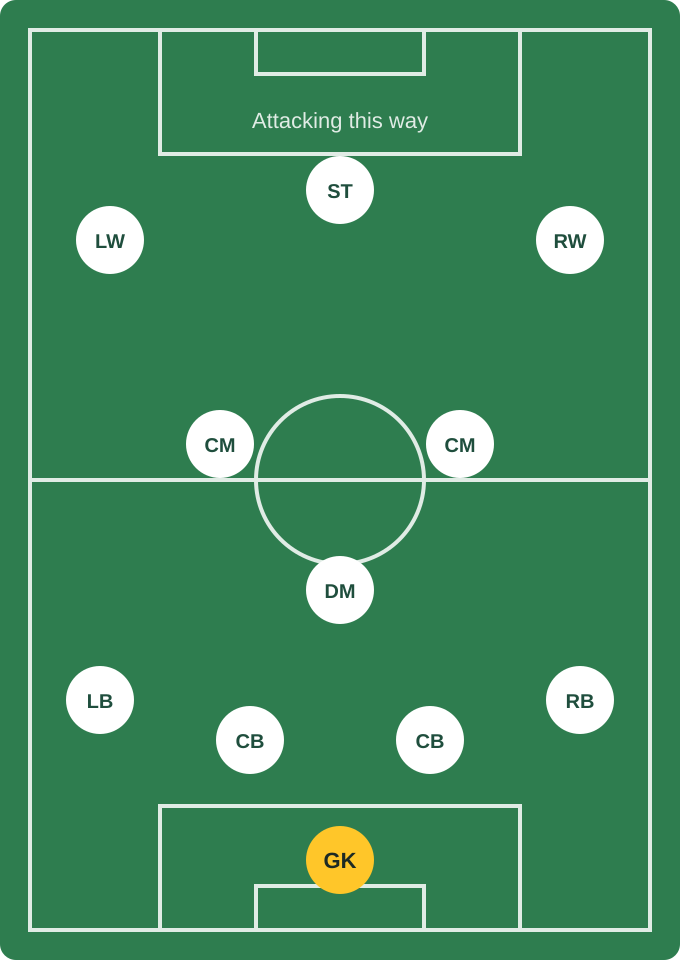
The 4-3-3 soccer formation uses four defenders, three midfielders and three forwards. It has been around since the 1960s and is one of the most popular attacking shapes today, from youth teams to the pros. The defense is compact: the back four plus a holding midfielder give you five players behind the ball, while the three forwards keep the other team's defenders busy.
| Line | Players | Main job |
|---|---|---|
| Defense | Left back, 2 center backs, right back | Center backs win headers and talk; full backs overlap on every attack |
| Midfield | Holding midfielder (DM), 2 central midfielders | The DM protects the defense and starts attacks; the two CMs create and support |
| Attack | Left winger, striker, right winger | Wingers stretch the field and beat defenders 1v1; the striker finishes |
New to the positions? See my soccer positions page for what each one does.
FREE5 Home Soccer Drills from Coach Armin
Plus SoccerManiak Weekly: my news round-up and one drill to try at home. Unsubscribe any time.
Defending in a 4-3-3
The two center backs are the backbone of the 4-3-3 soccer formation. They should be strong, good in the air and good at defending 1v1. Most of all, they need to talk all game: telling the players in front of them where to go, closing down empty space and stepping up together for the offside trap. If you are new to that, see my offside in soccer page or the official Law 11 Offside from The FA. If the offside trap isn't working, one center back can drop 5 to 10 yards behind the other and play as a sweeper.
The full backs are usually quick, agile players who are good on the ball. They need great fitness, because they run deep into attack to cross the ball and then sprint back when possession changes.
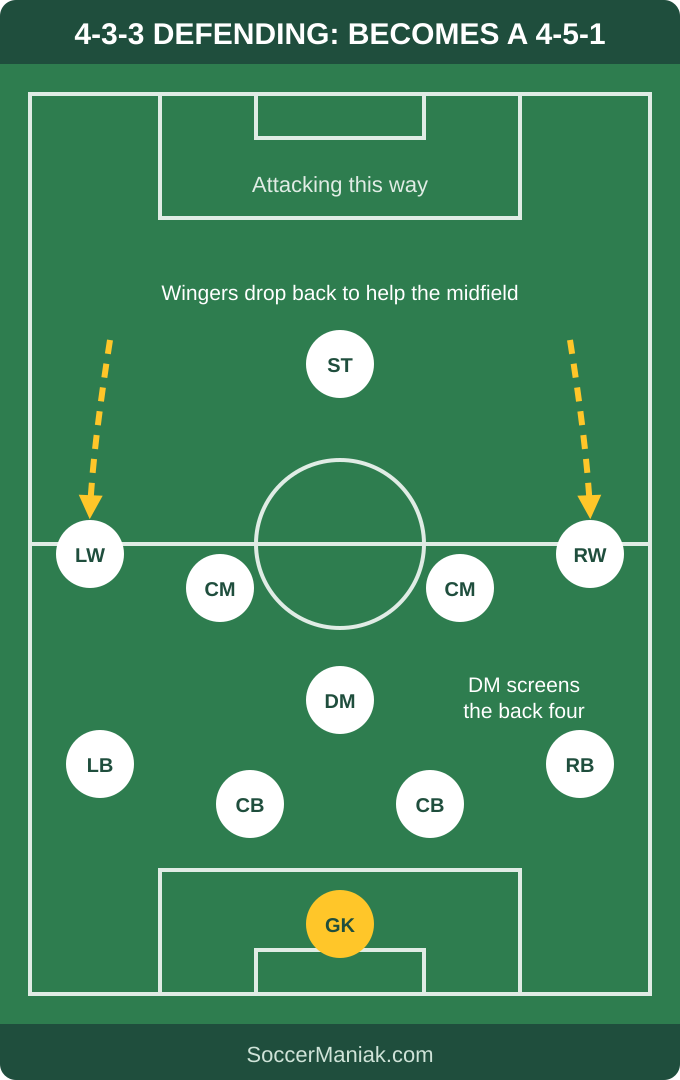
When the other team has the ball, the 4-3-3 defends best in zones. The wingers drop back next to the midfielders, so the shape becomes a 4-5-1, and nobody chases the ball across the field and leaves a hole behind them.
The Midfield in a 4-3-3
The midfield has only three players, so each one has a clear job. The holding midfielder (the 6) sits in front of the defense, stops attacks in the middle and starts almost every attack with calm, simple passes. This player needs to read the game well, be good in the air and stay composed with the ball.
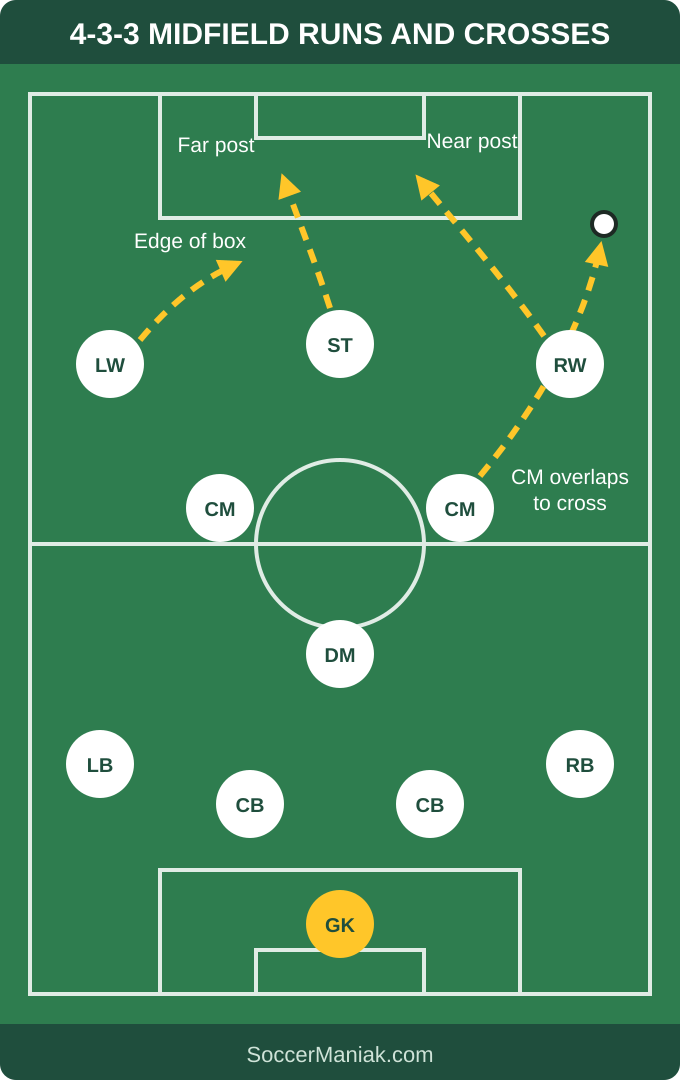
The two central midfielders are the creative players. They need good control, accurate through balls and the vision to spot teammates' runs. They often drift inside to open space for the wingers and full backs, and sometimes overlap a winger to cross. When they do, the forwards attack the box: one to the near post, one to the far post and one around the edge of the box.
The most important rule for this midfield trio: stay in your zone. If all three chase the ball to one side, the other team will find the space behind them. When the ball is lost, they get straight back into their zones and defend.
Attacking in a 4-3-3
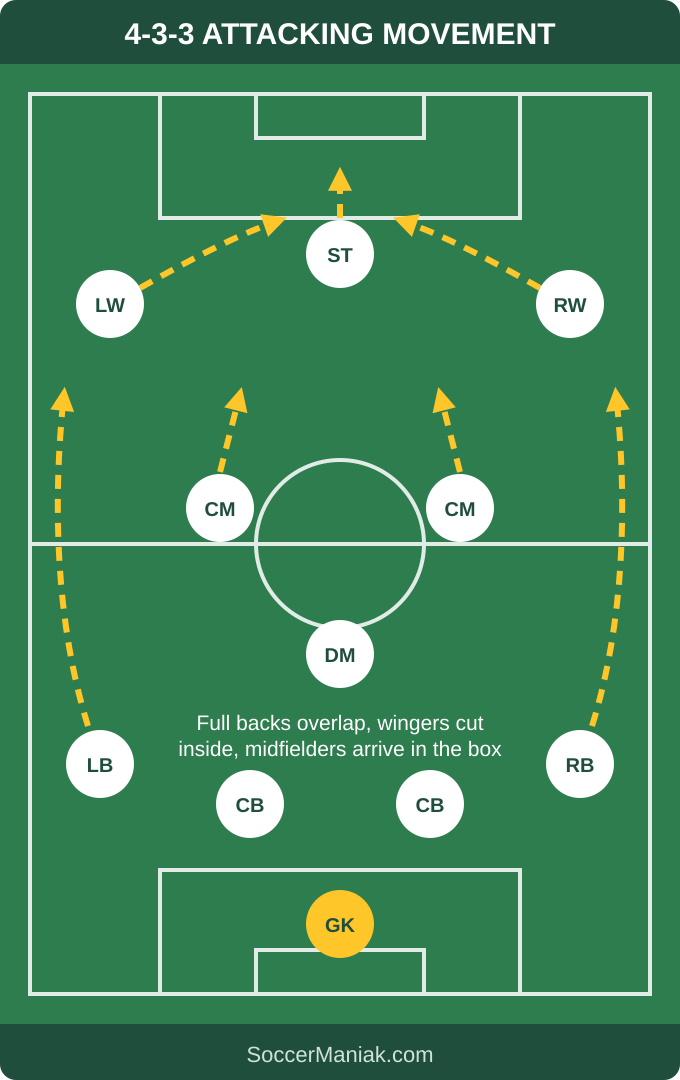
The attacking trio wins games in the 4-3-3 soccer formation. The two wingers are usually fast, great in 1v1s and good at crossing. They either stay wide to stretch the defense or cut inside to open the sideline for the full backs. The striker is often the team's top scorer, a strong finisher who is dangerous in the air.
The key to attacking in a 4-3-3 is movement. Players can't stand still: midfielders run inside, forwards spread to the wings, full backs overlap, and on every cross the forwards are in the box.
Strengths and Weaknesses of the 4-3-3
Strengths
- Lots of width from the wingers and full backs
- Three forwards keep the defense busy
- Strong pressing high up the field
- A holding midfielder protects the back four
- Easy to switch into a 4-5-1 to defend
Weaknesses
- A five-man midfield, like in a 3-5-2, can outnumber your three
- Full backs and wingers need a lot of stamina
- The holding midfielder can get overloaded
- Gets predictable if players stand still
In my experience, the 4-3-3 works well against teams with three or four defenders, like a 4-4-2 or a 3-4-3, and has the hardest time against teams that crowd the midfield.
Coaching Tips for the 4-3-3
- Pick a calm holding midfielder. The 6 touches the ball the most, so choose a player who stays composed and reads the game.
- Teach zones, not ball chasing. Mark the three midfield zones with cones in scrimmages so players learn where to stay.
- Train the crossing runs. Practice near post, far post and edge of the box until the forwards do it without thinking.
- Teach the wingers to drop. Make it a habit that the wingers come back into midfield when the ball is lost.
- Rotate tired legs. Full backs and wingers do the most running, so sub them early if they fade.
For practice ideas, see my passing drills, soccer shooting and youth soccer drills.
Common Questions About the 4-3-3 Soccer Formation
Is the 4-3-3 good for youth soccer?
Yes, for 11v11 teams with quick wingers and a calm midfielder. In 9v9, a 3-2-3 gives kids a similar shape with two wide players up top. See the youth formations on my soccer formations page.
What is the difference between a 4-3-3 and a 4-2-3-1?
A 4-3-3 has one holding midfielder and three forwards. A 4-2-3-1 has two holding midfielders, three attacking midfielders and only one striker, so it is a bit more defensive.
What does the number 6 do in a 4-3-3?
The 6 is the holding midfielder. They protect the back four, win the ball back and start attacks with simple passes.