3-4-3 Soccer Formation
The 3-4-3 soccer formation is one of the most attacking shapes in soccer: three center backs, four midfielders and three forwards. It can put five players around the box on every cross, but it needs a well-organized, experienced team. Below I explain how to defend with three center backs, what every midfielder and forward does, when to use it, and my coaching tips, with diagrams for each part.
On this page: At a glance Defense Midfield Attack Strengths and weaknesses Coaching tips Questions
The 3-4-3 Soccer Formation at a Glance
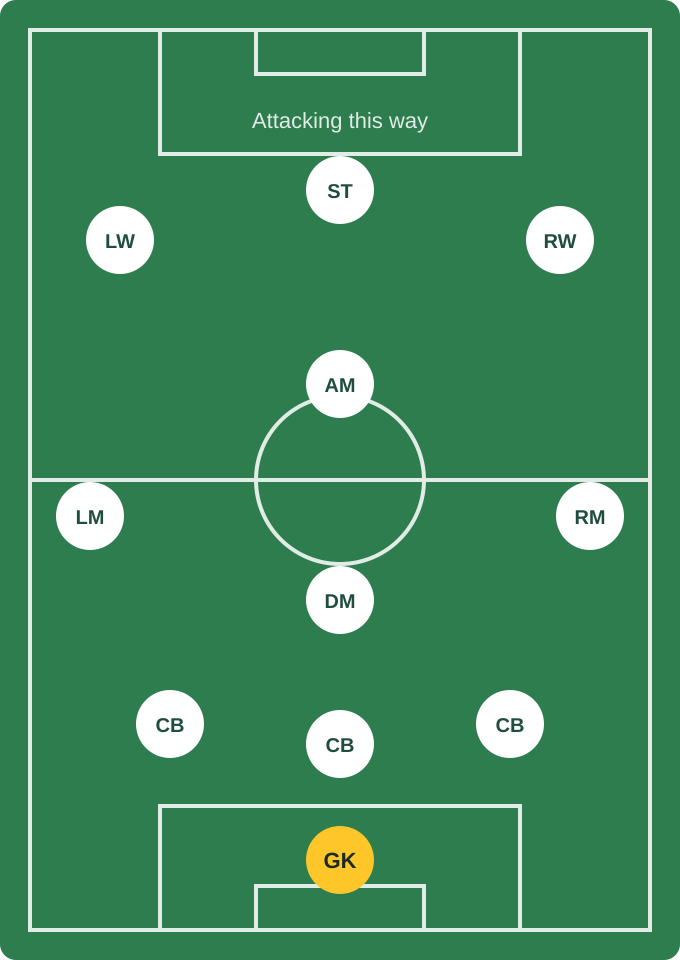
The 3-4-3 soccer formation uses three center backs, four midfielders and three forwards. It is one of the most attacking shapes in soccer. Its strength is the midfield and the forward line; its weakness is the three-man defense, which gets help from one central midfielder at all times.
Because it is so attacking, the 3-4-3 can be dangerous for your own team if you are not well organized. It works best for mature teams with a lot of experience defending in zones, and it should be practiced a lot before the season starts. I'd use it only when the other team plays with one, or at most two, attackers.
| Line | Players | Main job |
|---|---|---|
| Defense | 3 center backs | Talk constantly, step up together and stay close to the midfield |
| Midfield | Left mid, defensive mid, attacking mid, right mid | Wide mids overlap and cross; the DM protects; the AM creates |
| Attack | Left winger, striker, right winger | Beat defenders 1v1, cross and finish |
New to the positions? See my soccer positions page.
FREE5 Home Soccer Drills from Coach Armin
Plus SoccerManiak Weekly: my news round-up and one drill to try at home. Unsubscribe any time.
Defending in a 3-4-3
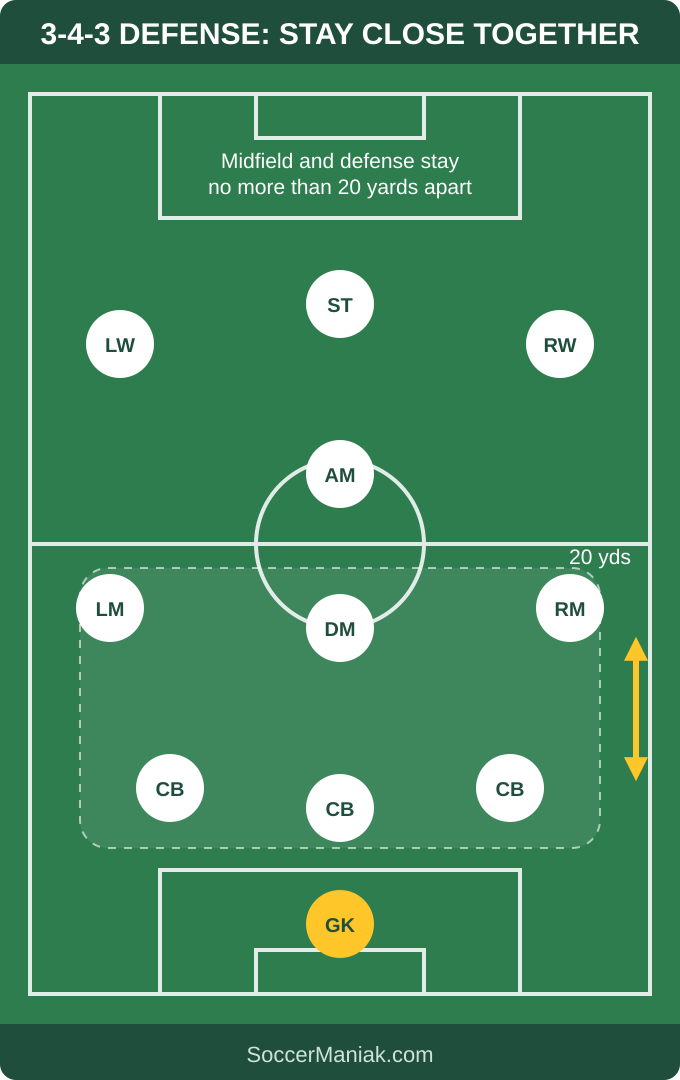
The three center backs line up across the field. They should be strong, good in the air and good at defending 1v1, and their talking needs to be at its best, because they are the backbone of the defense. They tell each other and the players in front of them where to go, close down every empty space and step up together for the offside trap. If you are new to that, see my offside in soccer page or the official Law 11 Offside from The FA.
If the other team has fast attackers who keep running behind your line, one center back can drop 5 to 10 yards behind the others as a sweeper and clean up those balls. The defenders don't have attacking jobs, except going up for free kicks and corners, where their height makes them dangerous.
One more key rule in the 3-4-3 soccer formation: keep the space between defense and midfield small. The two lines should be no more than about 20 yards apart.
The Midfield
The midfield has two wide players, a holding midfielder and an attacking midfielder. The wide midfielders need great fitness: they join every attack by overlapping the forwards and crossing into the box, then track back when the ball is lost. Beating defenders 1v1 and crossing well are crucial for this formation to work.
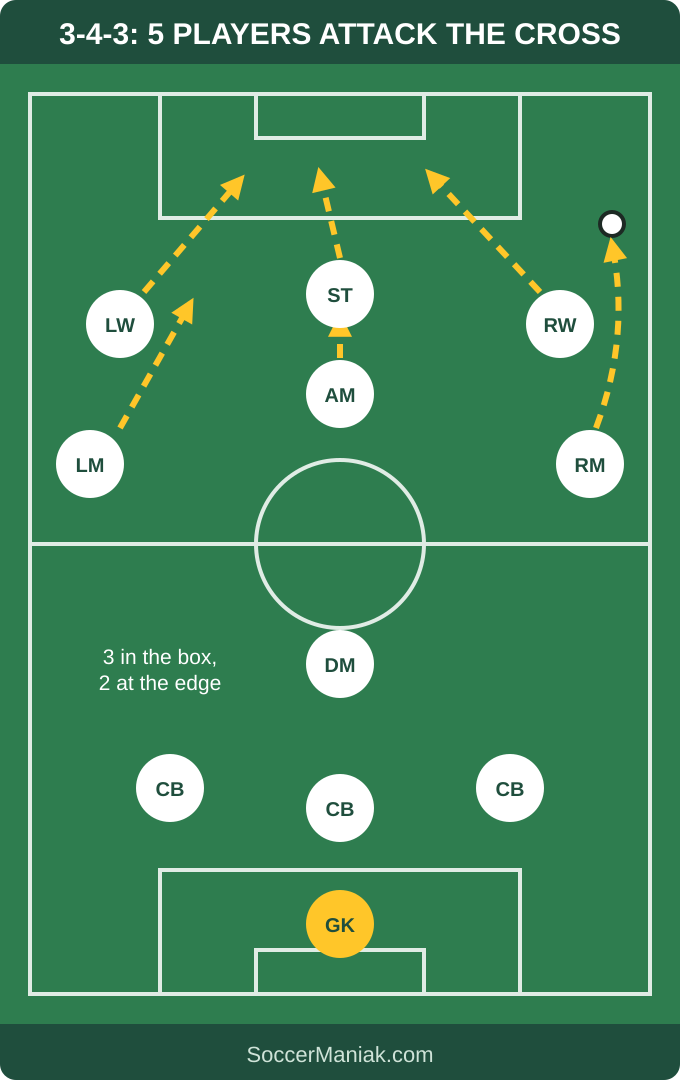
When the ball is crossed from one side, the three forwards attack the penalty box, while the far wide midfielder and the attacking midfielder wait at the edge of the box or even come in for a header. That is where this formation is most dangerous: five attacking players around the box looking to score.
The holding midfielder controls the middle by breaking up attacks, and starts most attacks too. They need to be strong, good in the air, great at defending 1v1, calm on the ball and good at passing, because their job is to stop attacks before they reach the center backs.
The attacking midfielder pushes forward whenever possible, which turns the midfield into a diamond in attack. This player needs great vision, ball control, passing and quick decisions, and should want the ball more than anyone. They help score by finding the wide players and forwards, or by scoring themselves. They also defend, so they need the fitness to run from one penalty box to the other.
Attacking in a 3-4-3
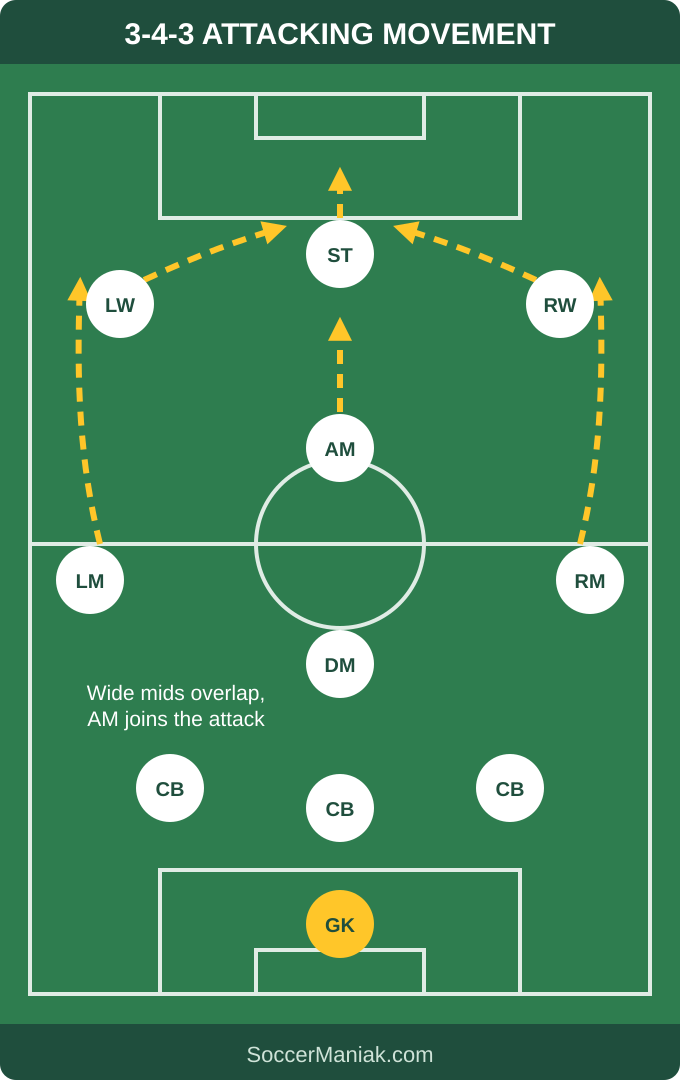
The attacking trio is very important for the 3-4-3 soccer formation to win games. The two wingers are usually very quick, great in 1v1s, good on the ball and good at crossing. They either run wide toward the sidelines or cut inside to open space for the wide midfielders. The striker is often tall, good in the air and a clinical finisher, and usually the team's top scorer. On every cross, the forwards need to be in the box.
The most important thing in attack is movement. Midfielders run inside, forwards spread to the wings, wide midfielders overlap the wingers. When defending, defend in zones: talk, close down space and don't chase the ball.
Strengths and Weaknesses of the 3-4-3
Strengths
- Very dangerous in attack
- Up to five players around the box on crosses
- Strong pressing high up the field
- Width from wingers and wide midfielders
Weaknesses
- Only three defenders
- Easy to counter attack if not organized
- Wide midfielders need huge stamina
- Needs a mature, experienced team
In my experience, the 3-4-3 is very effective against teams with three or four defenders, like a 4-4-2, and weakest against teams with lots of forwards, like a 4-3-3, because their three attackers go one on one with your three defenders.
Coaching Tips for the 3-4-3
- Practice it before the season. This shape needs a lot of training to stay organized.
- Choose the right games. Use it when the other team plays with one or two attackers, not three.
- Keep the lines close. Train defense and midfield to move together, no more than 20 yards apart.
- Train the crossing pattern. Three in the box, two at the edge, every time.
- Fit wide midfielders. Put your best runners there and rotate them when they tire.
For practice ideas, see my passing drills, soccer shooting and youth soccer drills.
Common Questions About the 3-4-3 Soccer Formation
Is the 3-4-3 a good formation for youth soccer?
Usually not as a first shape. It needs an experienced team that defends well in zones. Younger teams do better with a simpler shape, like the ones on my soccer formations page.
What is the difference between a 3-4-3 and a 3-5-2?
A 3-4-3 has three forwards and four midfielders. A 3-5-2 drops one forward into midfield, so it controls the middle better but has one less attacker.
Why is the 3-4-3 risky?
With only three defenders, a quick counter attack can leave them outnumbered. That is why the holding midfielder always stays back and the lines must stay close together.