4-2-3-1 Soccer Formation
The 4-2-3-1 soccer formation is a modern shape that attacks with lots of players and still stays very solid in defense: four defenders, two holding midfielders, three attacking midfielders and one striker. Below I explain how it defends in zones, what every position does, how one striker becomes four in attack, and my coaching tips, with diagrams for each part.
On this page: At a glance Zone defending Defenders Midfield Attack Strengths and weaknesses Coaching tips Questions
The 4-2-3-1 Soccer Formation at a Glance
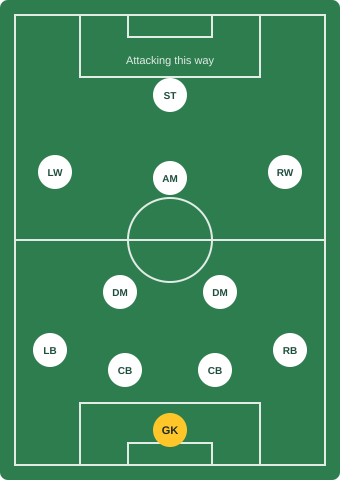
The 4-2-3-1 soccer formation uses four defenders, two defensive midfielders, three attacking midfielders and one striker. It is one of the most common shapes in the modern game because it does two things at once: it attacks with lots of players, and it stays very solid in defense. Its strength is the midfield and the overlapping full backs.
| Line | Players | Main job |
|---|---|---|
| Defense | Left back, 2 center backs, right back | Center backs lead and talk; full backs overlap and get back |
| Holding midfield | 2 defensive midfielders | Protect the back four, win the ball and start attacks |
| Attacking midfield | Left, center and right attacking midfielders | Create chances, join the striker, then track back |
| Attack | 1 striker | Win the ball in the air, hold it up and finish |
The main weakness: the three attacking midfielders sometimes forget they have to defend. If they don't get back quickly when the ball is lost, the two holding midfielders get overrun. As with any formation, set it up to suit the players you have, not the other way around. New to the positions? See my soccer positions page.
FREE5 Home Soccer Drills from Coach Armin
Plus SoccerManiak Weekly: my news round-up and one drill to try at home. Unsubscribe any time.
Zone Defending in a 4-2-3-1
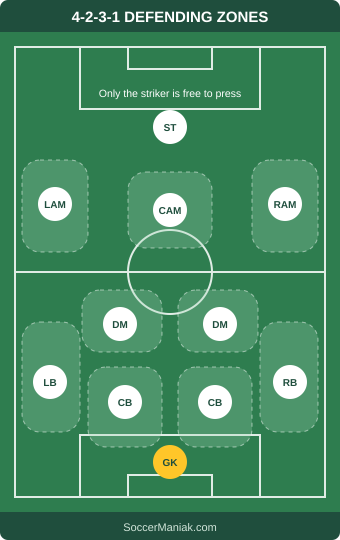
The most important part of winning with the 4-2-3-1 soccer formation is not getting scored on. Every player defends a zone, and talking is the key to making it work: who covers which space, who steps up, who stays. The only player with real freedom when defending is the striker, who can press the other team's defenders wherever the ball goes.
The Defenders
The back line has two center backs and two full backs. The center backs should be strong, good in the air, read the game well and stop players 1v1. They lead the defense by telling the players in front of them where to stand and who to mark, and they make sure the line steps up together for offside traps. If you are new to that, see my offside in soccer page or the official Law 11 Offside from The FA.
If you want to be even safer, one center back can drop 5 to 10 yards behind the other as a sweeper. The sweeper should be your best reader of the game, because from behind the line they can double up on any attacker.
The full backs are usually quick, agile players who are good on the ball. They need excellent fitness, because they run deep into attack and then track back when the ball changes hands. The good news: with two holding midfielders in front of them, the defenders get a lot of support.
The Midfield: Two Lines Working Together
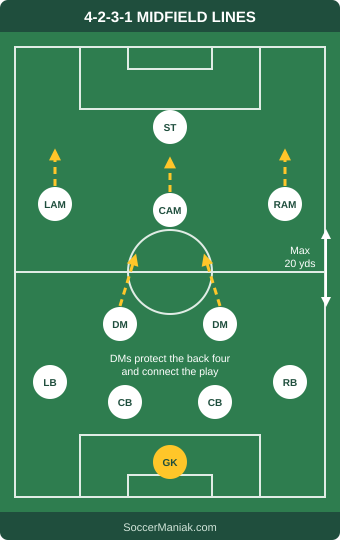
The two defensive midfielders are the backbone of the defense. They break up the other team's attacks, win tackles and headers, and stop the ball before it reaches the center backs. They also connect defense and attack, so they need solid passing and must stay calm when the ball comes to them.
The three attacking midfielders, left, center and right, are the creative force. They need great vision, great ball control, sharp passing and quick decisions, and they should be able to score. The left and right attacking midfielders spread the game toward the sidelines, while the central one pulls the strings in the middle. These are often the players who get the most touches in practice and always find space to get the ball.
The two lines have to move together. When defending, the holding midfielders shouldn't be more than about 20 yards from the attacking midfield line: when the holding pair drops back, the attacking midfielders follow. That's why these players run from one penalty box to the other all game.
The Attack: One Striker Becomes Four
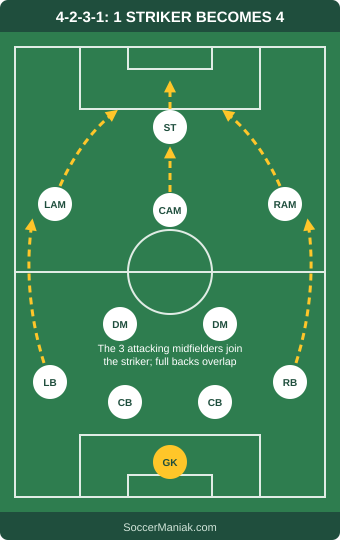
It looks like the 4-2-3-1 soccer formation has only one forward, but that isn't really the case. With solid defense behind them, the three attacking midfielders have the freedom to join every attack, and suddenly one striker turns into four.
The striker is usually a tall, strong target player who can win the ball in the air and shield it until help arrives. They also need to be a clinical finisher, able to score from the few chances they get.
Strengths and Weaknesses of the 4-2-3-1
Strengths
- Solid in defense with two holding midfielders
- Lots of players arrive in attack
- Strong, flexible midfield
- Works against most other formations
- Full backs can overlap safely
Weaknesses
- Attacking midfielders who don't track back leave gaps
- The lone striker can get isolated
- Full backs and wide attacking midfielders need a lot of stamina
- Needs good communication to defend zones
Coaching Tips for the 4-2-3-1
- Make tracking back a habit. Praise your attacking midfielders as much for getting back as for scoring.
- Teach the zones. Use cones in scrimmages to mark each player's zone, and freeze play to check everyone is in theirs.
- Keep the two lines close. Practice the holding pair and the attacking three moving up and back together.
- Choose a target striker. Your striker should be able to hold the ball up until teammates arrive.
- Fit the formation to your players. If you don't have a creative central attacking midfielder, a 4-4-2 or 4-3-3 may suit your team better.
For practice ideas, see my passing drills, soccer shooting and youth soccer drills.
Common Questions About the 4-2-3-1 Soccer Formation
Is the 4-2-3-1 good for youth soccer?
It can be, for older 11v11 teams with a creative attacking midfielder and players who will track back. For younger teams, simpler shapes work better. See the youth formations on my soccer formations page.
What is the difference between a 4-2-3-1 and a 4-3-3?
A 4-2-3-1 has two holding midfielders and one striker. A 4-3-3 has one holding midfielder and three forwards, so it puts more players high up the field from the start.
Is the 4-2-3-1 a defensive or attacking formation?
Both. The two holding midfielders make it solid, and the three attacking midfielders make it dangerous going forward. When defending, it can look like a 4-5-1.