4-4-2 Soccer Formation
The 4-4-2 soccer formation is the classic shape in soccer: four defenders, four midfielders and two strikers. It is simple, balanced and still one of the best formations for teams moving up to 11v11. Below I explain how the 4-4-2 attacks and defends, the diamond and sweeper versions, its strengths and weaknesses, and my coaching tips, with diagrams for each one.
On this page: At a glance Attacking Defending Diamond 4-4-2 Sweeper version Strengths and weaknesses Coaching tips Questions
The 4-4-2 Soccer Formation at a Glance
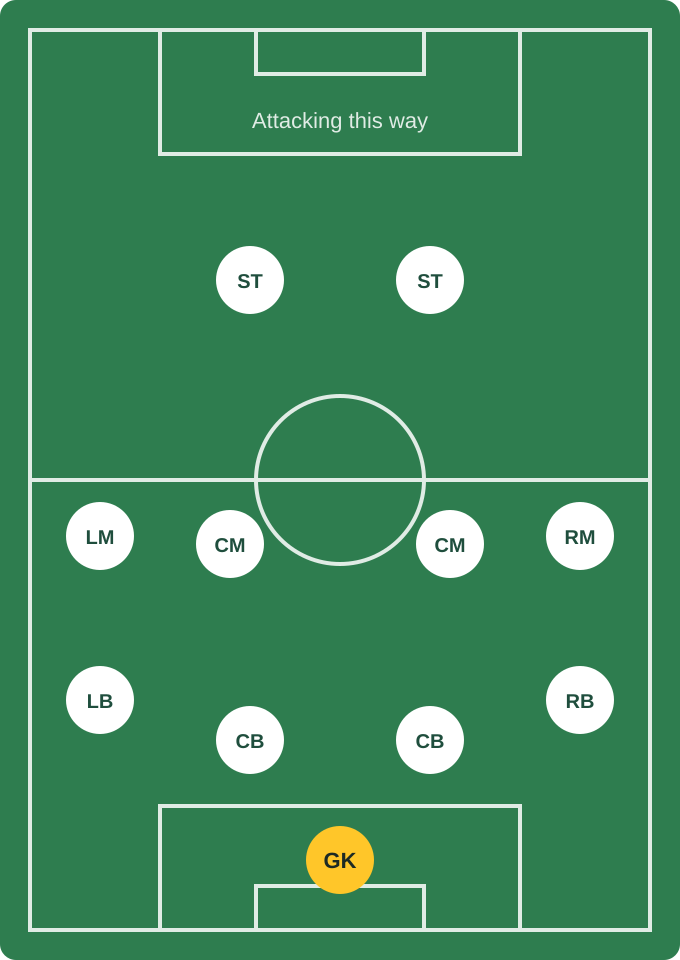
The 4-4-2 soccer formation uses four defenders, four midfielders and two forwards in front of the goalkeeper. It is one of the oldest and most common shapes in the game, and still one of the easiest to learn, because every player has a clear partner: two center backs, two full backs, two central midfielders, two wide midfielders and two strikers.
| Line | Players | Main job |
|---|---|---|
| Defense | Left back, 2 center backs, right back | Stay compact, step up together, full backs overlap in attack |
| Midfield | Left mid, 2 central mids, right mid | One central mid holds, one supports the strikers; wide mids cover the whole sideline |
| Attack | 2 strikers | Work as a pair: one target player, one runner |
New to the positions? See my soccer positions page for what each one does.
FREE5 Home Soccer Drills from Coach Armin
Plus SoccerManiak Weekly: my news round-up and one drill to try at home. Unsubscribe any time.
Attacking in a 4-4-2
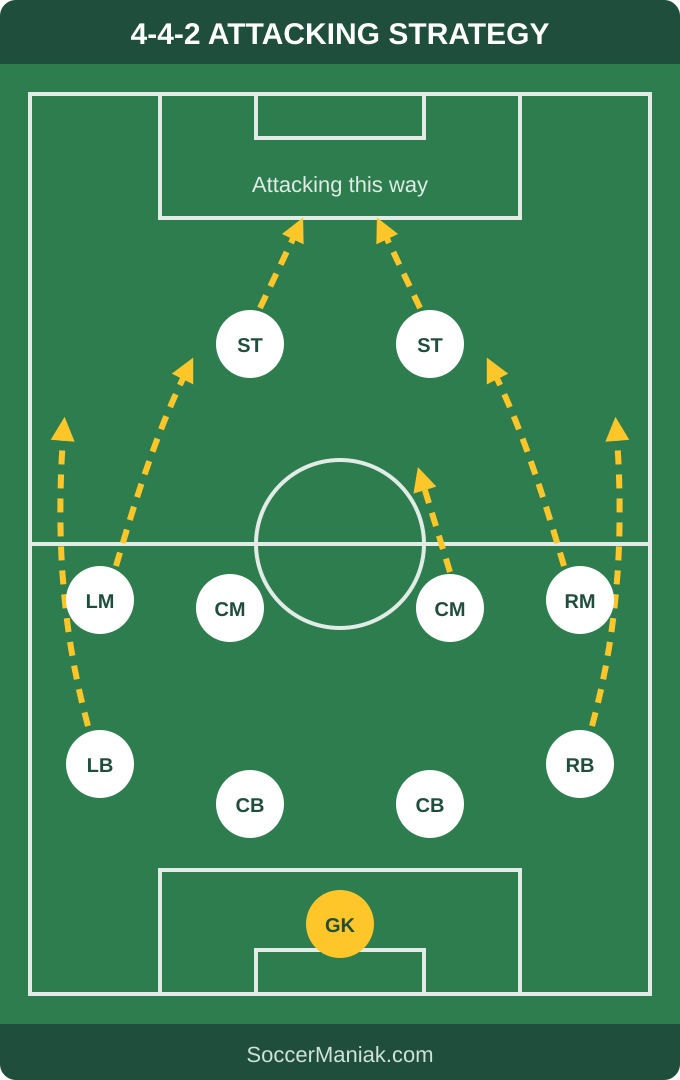
The strength of the 4-4-2 in attack comes from the full backs. When the left back and right back overlap the wide midfielders, the team suddenly has extra players in the other team's half, and the 4-4-2 turns into something closer to a 2-4-4.
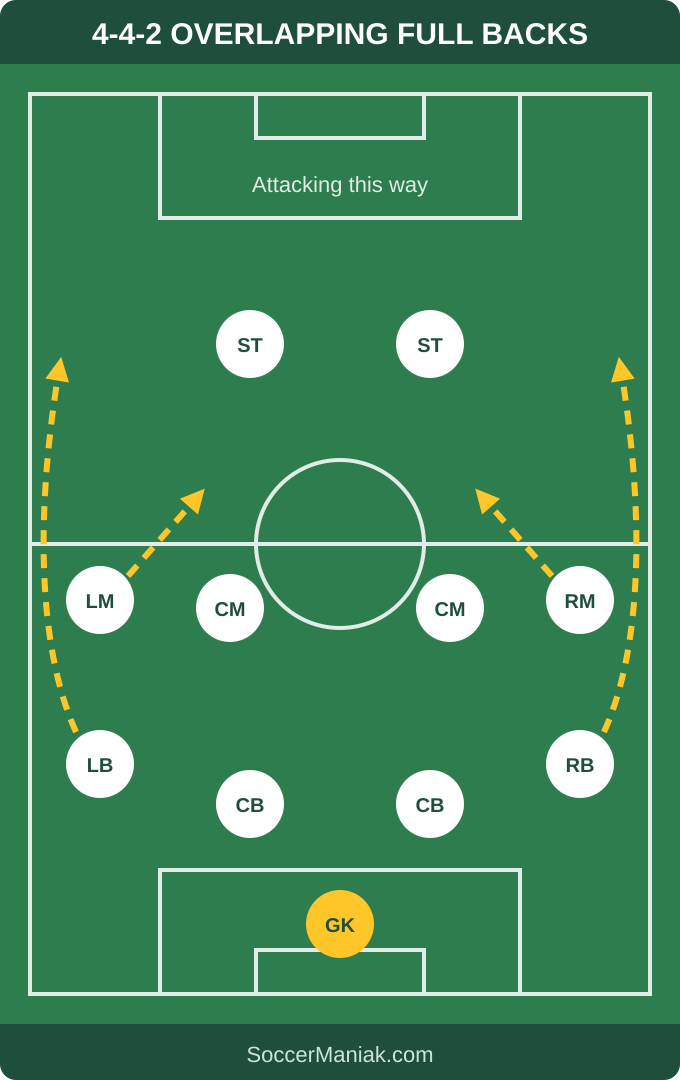
That is why the outside players need to be in great shape. They run the most on the team: forward to support and cross, then all the way back to defend. In the middle, the two central midfielders should stay no more than about 20 yards apart, so they can always pass to each other. Usually one plays a more defensive role while the other pushes forward to support the strikers.
Defending in a 4-4-2
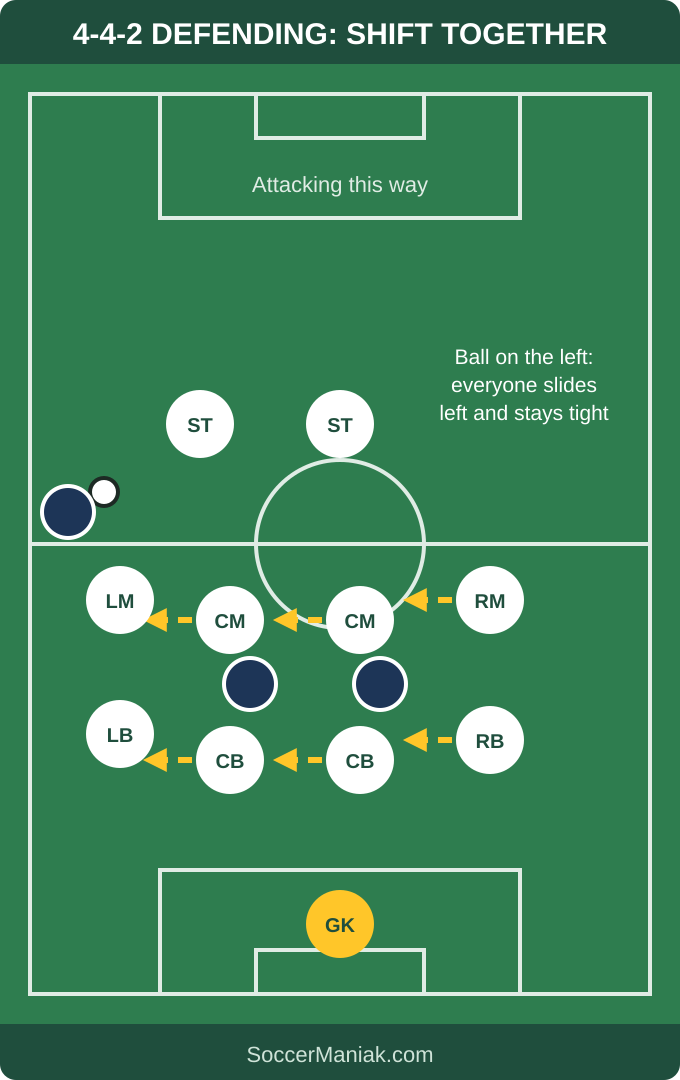
When defending, the two lines of four stay compact and move together as one unit. If the ball is on the left, everyone slides left, so there are no big gaps to play through. The weakness of a flat back four is the space behind it. Quick forwards who make diagonal runs behind the defense can cause real problems.
That is why 4-4-2 defenders often use the offside trap, stepping up together at the right moment. It only works with constant talking, so one player, usually a center back, needs to call it out loud. If your team is still learning offside, read my offside in soccer page or the official Law 11 Offside from The FA.
The Diamond 4-4-2
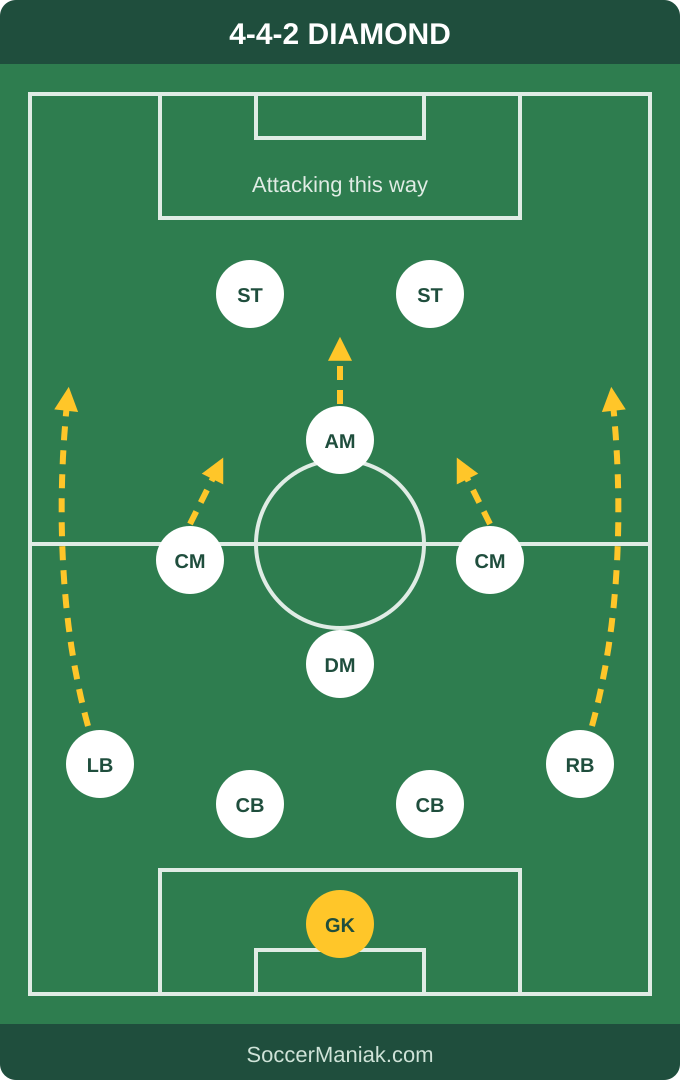
Another popular way to play the 4-4-2 soccer formation is with a diamond in midfield. Instead of two wide midfielders, you get a defensive midfielder at the bottom, two central playmakers on the sides and an attacking midfielder at the top, right behind the strikers.
The defensive midfielder slows down the other team's attacks, so both full backs can push forward at the same time. The central midfielders need great passing and vision to spot runs. The downside: with no natural wide midfielders, the diamond can be exposed on the sides and on counter attacks.
The 4-4-2 With a Sweeper
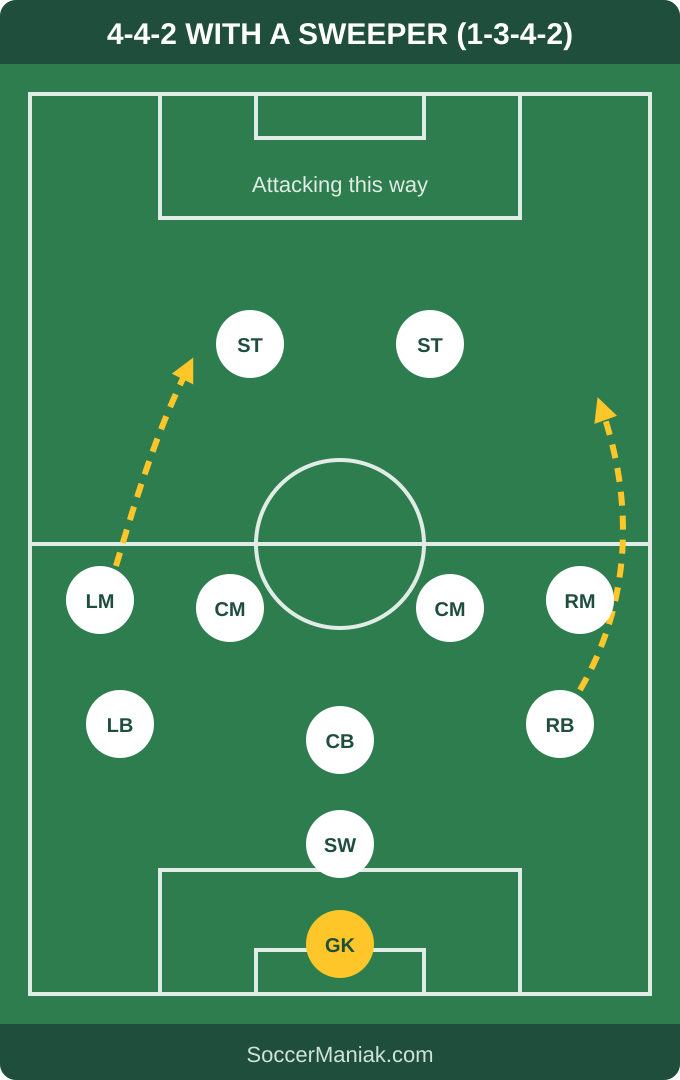
If your defense struggles with the offside trap, or the other team has very quick forwards, you can drop one center back behind the defense as a sweeper. The sweeper has no player to mark and cleans up any ball that gets through. This shape is often called a 1-3-4-2.
The trade-off is in attack. Only one full back can go forward at a time: if the attack goes down the right, the right back joins it while the left back stays home, and the other way around.
Strengths and Weaknesses of the 4-4-2
Strengths
- Easy to learn and teach
- Every player has a partner
- Balanced in attack and defense
- Two strikers keep both center backs busy
- Good width from the wide midfielders
Weaknesses
- Three central midfielders, like in a 4-3-3, can outnumber your two
- Space behind a flat back four
- Wide players and full backs need a lot of stamina
- Can get predictable if the team only goes down the sides
Coaching Tips for the 4-4-2
- Great first 11v11 shape. When a youth team moves up to 11v11, the 4-4-2 is a simple, balanced place to start.
- Train the pairs. Center back pairs, central midfield pairs and striker pairs should practice together, so they know where their partner will be.
- Fitness for the wide players. Pick full backs and wide midfielders who love to run, and rotate them if they get tired.
- Practice stepping up together. Work on the back four moving as one line, with one leader calling it.
- Adjust to your players. Experiment with the flat, diamond or sweeper version until it fits the players you have. Every player has to pull their weight to make any formation work.
For practice ideas, see my passing drills and youth soccer drills.
Common Questions About the 4-4-2 Soccer Formation
Is the 4-4-2 good for youth soccer?
Yes. For teams playing 11v11, it is one of the best shapes to start with, because every player has a clear area and a clear partner. Younger teams playing 7v7 or 9v9 use smaller shapes, which you can see on my soccer formations page.
What is the difference between a flat 4-4-2 and a diamond 4-4-2?
A flat 4-4-2 has two wide midfielders and two central midfielders side by side. A diamond 4-4-2 has one defensive midfielder, two central midfielders and one attacking midfielder, with no natural wide players.
How do you beat a 4-4-2?
Teams often play three central midfielders, like in a 4-3-3 or 4-2-3-1, to outnumber the two in the middle of a 4-4-2, or send quick runners in behind the back four.